
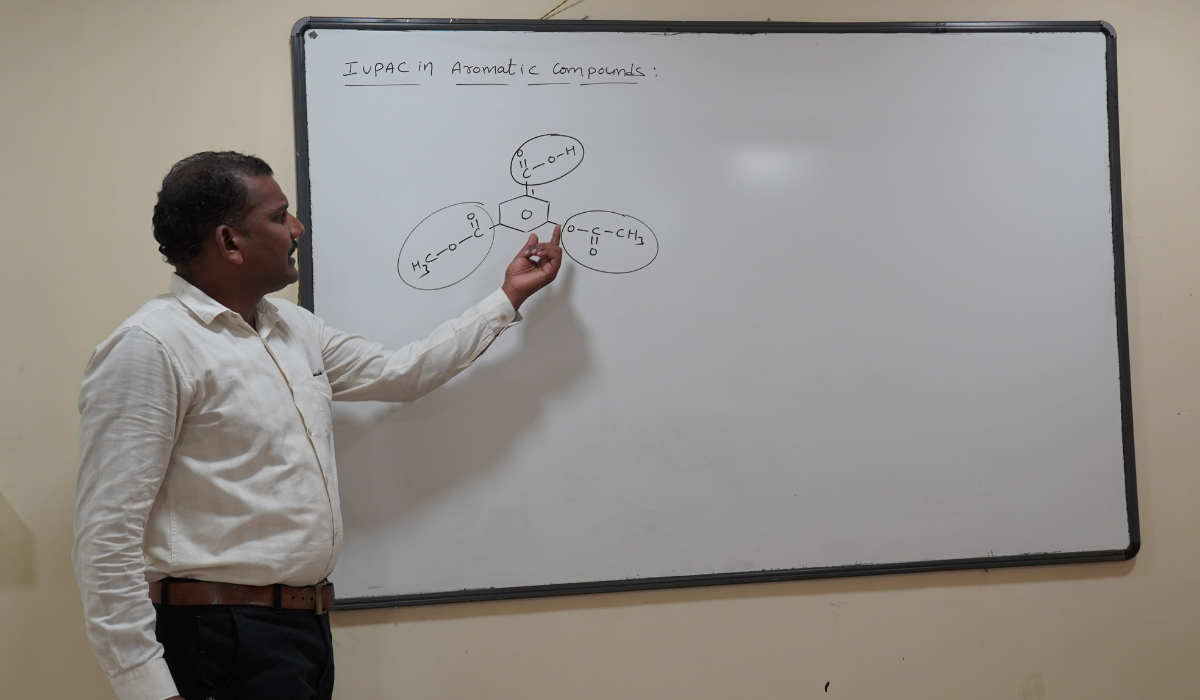
The biggest trap medical and engineering aspirants fall into is treating Organic Chemistry like Biology or History, attempting to cram hundreds of named reactions line by line. But Organic Chemistry is fundamentally logical. Once you understand why electrons move the way they do, reaction mechanisms become predictable, and reliance on rote memorization drops drastically.
At Ideal VIITJEE Academy, we teach our students to stop passive cramming and start using structural, logic-based frameworks. Here is the step-by-step strategy to master Organic Chemistry reactions for NEET, JEE, and KCET without burning out.
Almost every single reaction in NEET and JEE Organic Chemistry boils down to one fundamental principle:
$$ ext{Electron-Rich (Nucleophile)} longrightarrow ext{Electron-Poor (Electrophile)}$$
Instead of memorizing products blindly, always identify these three components first:
The Substrate: Where is the partial negative or partial positive charge?
The Reagent: Is it looking for electrons (Electrophile) or donating electrons (Nucleophile)?
The Reaction Center: Which bond is weakest or most polarized?
When you understand electron movement, you don't need to memorize what happens when an alkene meets $ ext{HBr}$—you simply follow the negative charge attacking the positive center.
To learn more about our conceptual teaching methodology and academic mentorship, visit our about us page.
Textbooks divide organic chemistry into separate chapters like Haloalkanes, Alcohols, and Aldehydes. Studying chapter-by-chapter can make it feel like there are hundreds of unrelated reactions.
In reality, there are only 5 core mechanism types in the entire syllabus:
Nucleophilic Substitution ($S_N1, S_N2$)
Electrophilic Addition (Alkenes & Alkynes)
Electrophilic Aromatic Substitution (Benzene derivatives)
Nucleophilic Addition (Aldehydes & Ketones)
Elimination ($E1, E2$)
When you group reactions by mechanism, you'll realize that Aldol Condensation, Cannizzaro, and Grignard Addition all share the exact same starting logic: a nucleophile attacking a carbonyl carbon ($ ext{C=O}$).
For middle school students building early scientific logic, our foundation classes establish analytical reasoning skills long before high school. Parents can also read our guide on how parents can support foundation course students to build disciplined study habits early.
Linear lists of reactions are hard to retain. Your brain processes spatial maps much faster than plain text.
Create Conversions Roadmaps centered around core functional groups. For example, put an Alcohol in the center of a page and draw arrows extending outward to show all possible conversions (e.g., Oxidation to Carboxylic Acid, Dehydration to Alkene, Substitution to Alkyl Chloride).
When you practice connecting compounds visually, solving complex 3-step conversions in entrance exams becomes a straightforward path-finding exercise.
At Ideal VIITJEE, our integrated coaching program combines board exam preparations with entrance test problem-solving techniques under a single synchronized schedule.
Reagents are the tools of Organic Chemistry. Instead of memorizing every individual reaction, learn the specific behavior and job description of key reagents:
| Reagent | Personality / Function |
| $ ext{LiAlH}_4$ | Strong Reducer: Converts carbonyl compounds ($ ext{C=O}$, $ ext{-COOH}$) all the way to alcohols. |
| PCC | Mild Oxidizer: Stops oxidation cleanly at the Aldehyde stage without converting to Carboxylic Acid. |
| $ ext{Conc. H}_2 ext{SO}_4$ | Dehydrating Agent: Removes $ ext{H}_2 ext{O}$ to form alkenes. |
| Alcoholic $ ext{KOH}$ | Elimination Specialist: Removes hydrogen and halogens to form double bonds ($E2$). |
| Aqueous $ ext{KOH}$ | Substitution Specialist: Replaces halogens cleanly with an $ ext{-OH}$ group ($S_N$). |
Knowing what a reagent likes to do allows you to predict products even for unfamiliar reactions.
Mastering Organic Chemistry requires strategic revision modules during high-stakes exam months:
For Fast-Track Exam Revision: Short-term modules like a NEET crash course or KCET revision sprint help students refine test speed and accuracy during the final 60 days before exams.
For Dropper & Gap-Year Candidates: A comprehensive long term NEET course providing full-year conceptual rebuilding and daily practice tests.
For Stress-Free Motivation: Learning how to stay motivated during NEET preparation and KCET cycles is significantly easier when students have direct access to local faculty mentors in Kalaburagi.
To see how our students achieve national and state percentile ranks, review our report on celebrating excellence: Ideal VIITJEE Academy students shine in NEET results.
If you are evaluating local coaching options, check our guide on the top 5 questions parents ask before choosing a NEET coaching centre to evaluate faculty experience, batch size, and test series quality.
For students exploring alternate academic roadmaps, review our guide on what to do after failing NEET: 5 realistic options for medical aspirants.
Read NCERT Line-by-Line: For NEET and KCET, the vast majority of organic questions are drawn directly from NCERT examples, in-text questions, and exercise problems.
Practice Active Recall: Cover the product side of an equation with your hand and force yourself to write the product on a blank sheet from memory.
Trace Carbon Counts: Always count the main carbon chain before and after a reaction to avoid losing or adding carbons accidentally.
Master Organic Chemistry and secure your top competitive rank with expert mentorship from Ideal VIITJEE Academy. We offer experienced faculty, detailed mechanism training, and comprehensive test series right here in Kalaburagi.
Step 1: Visit our admission portal to explore upcoming batch schedules and scholarship tests.
Step 2: Reach out through our contact page to schedule a personal counseling session with our senior faculty.
Step 3: Visit our campus at the NEET Coaching Center in Kalaburagi to inspect our classrooms and take the first step toward academic success!