
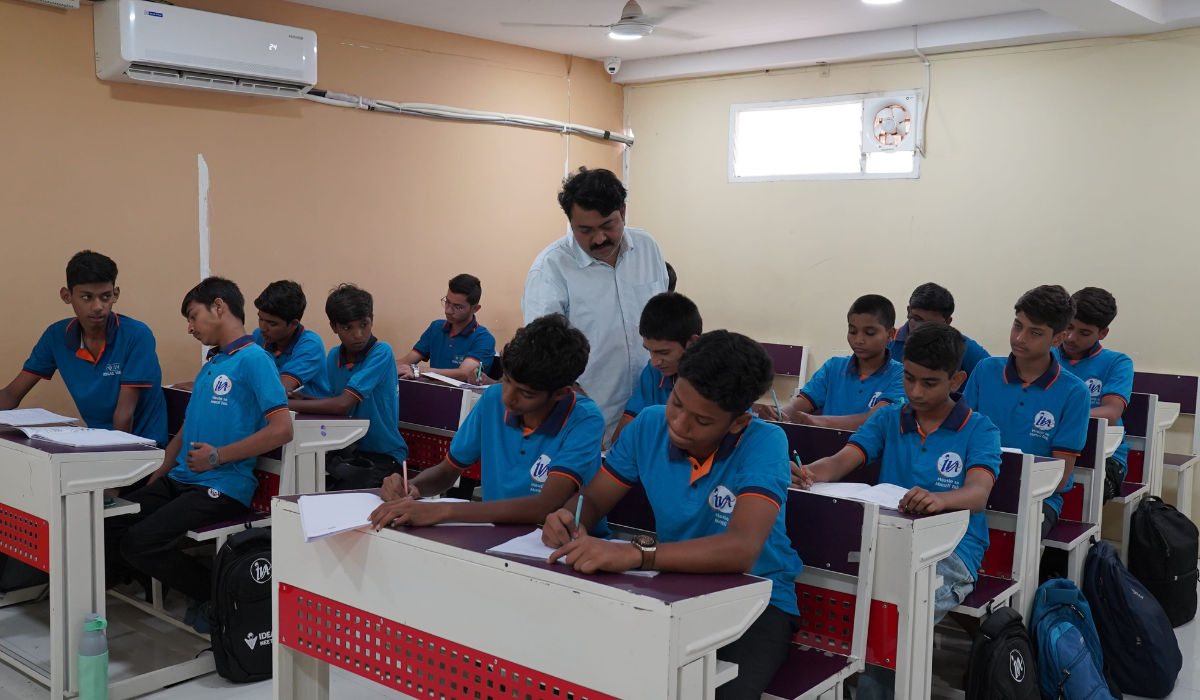
Stepping into Pre-University (1st PU and 2nd PU / Class 11 & 12) is one of the most demanding phases of a student's academic journey. For science aspirants across Karnataka, these two critical years require balancing board examination requirements with competitive entrance tests like NEET, JEE, and KCET.
The most common challenge students face during this transition is not a lack of effort or intelligence—it is poor time management. Trying to complete college lectures, practical lab work, coaching classes, and self-study without a structured daily roadmap quickly leads to mounting backlogs, sleep deprivation, and severe mid-term burnout.
To help students across Kalaburagi build a disciplined, stress-free routine, Ideal VIITJEE Academy has put together an actionable time management guide and daily framework designed for entrance exam success.
Why do so many PU students struggle with time? The primary reason is the fundamental difference in how board exams and competitive entrance tests evaluate your knowledge:
Board Examinations (1st & 2nd PU): Demand descriptive step-by-step derivations, long-answer essays, labeled diagrams, and precise textbook definitions.
Entrance Examinations (NEET, JEE, KCET): Demand high-speed numerical problem solving, application of concepts under strict time limits, and negative-marking control.
When students treat board preparation and entrance preparation as two completely separate tasks, they effectively double their workload.
At Ideal VIITJEE, our integrated coaching approach solves this problem by synchronizing state board syllabi with competitive entrance patterns under one unified timetable, saving students hundreds of hours of redundant studying.
To learn more about our academic culture and expert faculty, visit our about us page.
Effective time management begins with knowing where to focus your daily energy. Applying the 70/30 Rule ensures steady progress across both academic fronts:
70% Active Problem-Solving: Spend the majority of your self-study time solving multiple-choice questions (MCQs), practicing numerical applications in Physics and Physical Chemistry, and testing active recall for Biology and Organic Chemistry.
30% Descriptive & Conceptual Review: Dedicate the remaining time to reviewing NCERT textbook lines, practicing circuit diagrams, and memorizing board derivations.
For younger students, developing these analytical study habits early through foundation classes during middle school makes the transition to 1st PU feel natural and manageable. Parents can also read our guide on how parents can support foundation course students to establish healthy study routines at home.
Here is a realistic, time-tested daily schedule designed for students balancing PU college and competitive preparation:
| Time Slot | Activity | Focus Area |
| 6:00 AM – 7:00 AM | Morning Flash Revision | High-yield formula review or line-by-line NCERT Biology scanning |
| 8:00 AM – 2:00 PM | Integrated College & Lectures | Attending concept classes and practical laboratory sessions |
| 2:30 PM – 4:00 PM | Rest & Mental Unwind | Lunch, rest, and complete mental detachment from study |
| 4:00 PM – 6:00 PM | Self-Study Block 1 (Physics) | 2 hours of timed numerical problem-solving and formula application |
| 6:00 PM – 6:30 PM | Evening Break | Physical activity, brief walk, or light refreshment |
| 6:30 PM – 8:30 PM | Self-Study Block 2 (Chemistry) | Practice organic reaction mechanisms or inorganic memorization |
| 8:30 PM – 9:30 PM | Dinner & Family Time | Unwind and enjoy dinner with family |
| 9:30 PM – 11:00 PM | Self-Study Block 3 (Biology/Math) | Solve targeted MCQs and maintain your Error Notebook |
| 11:00 PM | Sleep | Non-negotiable 7 hours of sleep for memory consolidation |
Never waste time re-solving questions you already know how to answer. Keep a dedicated notebook where you record every wrong answer, calculation mistake, or forgotten formula from your practice papers. Reviewing this error notebook every Sunday provides maximum score improvement in minimum time.
Consistency beats intensity every single time. Studying 4 to 5 hours consistently every day yields far better long-term retention than studying 14 hours on weekends while doing nothing on weekdays.
During the final 60 days following board exams, enroll in targeted fast-track programs like a NEET crash course or KCET sprint to sharpen your test-taking speed and OMR bubbling accuracy.
For droppers and repeaters who require full-time rank boosting, a dedicated long term NEET course allows for 8 to 10 hours of daily focused study without board exam distractions.
Managing tight schedules during Pre-University can occasionally cause anxiety. Learning how to stay motivated during NEET preparation and KCET testing cycles is significantly easier when you study locally in Kalaburagi under the personal guidance of accessible mentors.
To see how our students achieve top percentile ranks while maintaining balanced daily routines, read our performance report on celebrating excellence: Ideal VIITJEE Academy students shine in NEET results.
If you are a parent evaluating local coaching institutes, check our guide on the top 5 questions parents ask before choosing a NEET coaching centre to evaluate batch sizes, test frequency, and faculty availability.
For students exploring alternate academic roadmaps, review our guide on what to do after failing NEET: 5 realistic options for medical aspirants.
Protect Your Sleep: Sleeping less than 6 to 7 hours impairs analytical reasoning and slows down your problem-solving speed during Physics tests.
Minimize Phone Distractions: Put your smartphone on Airplane Mode or place it in another room during self-study blocks.
Analyze Every Mock Test: Spend at least 90 minutes analyzing every test paper to identify exact time-wasting habits during the exam.
Master time management and achieve your dream competitive rank with expert guidance from Ideal VIITJEE Academy. We offer experienced competitive faculty, synchronized integrated PU schedules, and personalized mentorship right here in Kalaburagi.
Step 1: Visit our admission portal to view upcoming batch schedules and register for scholarship tests.
Step 2: Reach out through our contact page to schedule a personal counseling session with our senior faculty.
Step 3: Visit our campus at the NEET Coaching Center in Kalaburagi to inspect our classrooms and take the first step toward academic success!