
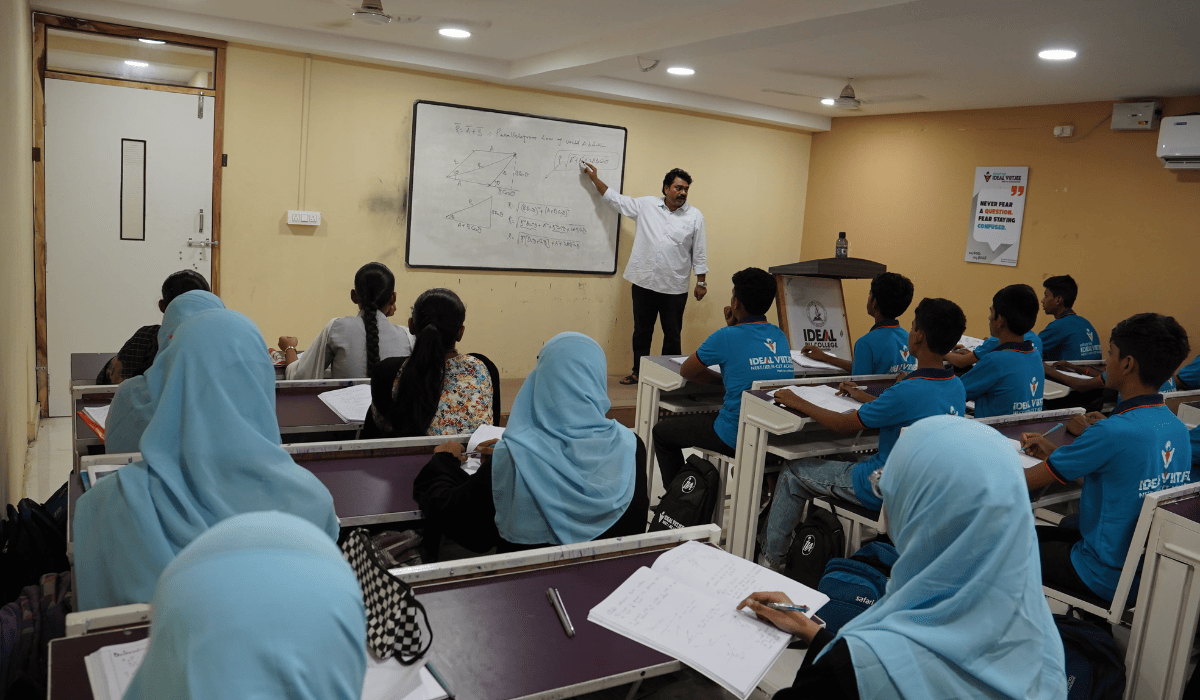
Classes 8, 9, and 10 represent the most transformative academic phase in a student's life. During these critical years, education shifts away from simple rote memorization and surface-level recall toward analytical logic, multi-step problem solving, and deep conceptual clarity. For students aspiring to crack competitive national examinations, understanding the true benefits of starting NEET JEE prep early with foundation training shapes their entire future academic trajectory
At Ideal VIITJEE Academy in Kalaburagi, our experienced faculty members regularly observe that students who succeed in competitive exams are rarely those who pull all-nighters or study under high stress. Instead, top achievers are those who quietly build dependable routines through dedicated foundation classes for class 8 9 10. Cultivating sustainable habits early removes the overwhelming pressure students often face when stepping into Pre-University (PU) or Class 11.
In primary school, memorizing question-and-answer pairs often yields decent grades. However, as science and mathematics expand in Class 8, 9, and 10, rote memorization breaks down completely. This pedagogical difference is precisely why parents must recognize the fundamental difference between foundation and regular tuition classes.
The Problem: Memorizing formulas, laws, and chemical reactions without grasping the foundational derivation leads to confusion when questions are slightly twisted in higher-level tests.
The Solution: Adopt the "first-principles" mindset encouraged in the classrooms at Ideal VIITJEE. Whenever you learn a new theorem in geometry or a law of motion in physics, ask yourself three essential questions:
Why does this principle work this way?
What real-world phenomenon does it explain?
Can I explain this concept to a classmate in plain language without looking at the book?
When you can teach an idea simply, you have mastered it permanently.
Re-reading a chapter four or five times gives a misleading sense of familiarity called the "illusion of competence." You recognize the sentences on the page, but your brain cannot retrieve the knowledge independently during an examination.
Write as You Read: Always keep a notebook open next to your textbook. Summarize paragraphs into concise bullet points, draw arrows to show cause-and-effect in biology, and implement practical note taking methods that actually help you revise
Maintain Dedicated Formula and Derivation Registers: Keep a separate, slim notebook strictly for physics formulas, mathematical identities, and chemistry valency tables. When you write formulas by hand every week, muscle memory pairs with mental recall, cutting calculation errors during timed tests.
Mathematics and physical sciences cannot be studied through passive reading. Reading solutions is like watching someone else exercise at the gym—it looks straightforward, but it builds no personal strength. Applying systematic problem solving strategies for JEE mathematics early trains your mind to break down complex questions effortlessly.
Daily Numerical Quota: Class 8 and 9 students should solve at least 15 to 20 varied mathematical and scientific problems daily. Class 10 students should push this to 25 to 30 problems.
Work from a Blank Sheet: When attempting exercise problems, cover the solution completely. Struggle through the steps, test alternate formulas, and make mistakes on paper. The cognitive effort spent trying to solve an unsolved question is where genuine conceptual neural pathways are built.
Forgetting is a natural biological mechanism. The human brain rapidly discards unused information unless it receives deliberate signals that the data is essential for long-term survival and success.
At Ideal VIITJEE, our mentors teach students the Three-Tier Revision Cycle:
Tier 1 (Same-Day Review): Spend 20 minutes every evening reviewing the exact topics taught in your academy lectures that day. This cements the concept into short-term memory before sleep.
Tier 2 (Weekly Consolidation): Reserve Sunday mornings exclusively for reviewing the past six days of coursework. Create one-page summary flowcharts or flashcards.
Tier 3 (Monthly Diagnostic Review): Once every four weeks, revisit older chapters taught at the beginning of the term and solve mixed problem sets to ensure zero memory decay.
One of the largest shocks Class 10 students face when taking competitive diagnostic tests is the ticking clock. In school board formats, students have ample time to write long-form descriptive answers. In competitive environments, speed and accuracy must coexist seamlessly.
Set a Stopwatch: Whenever you sit down to solve a worksheet of 20 questions, set a countdown timer on your desk. Using time-blocking frameworks like the Pomodoro technique for NEET JEE aspirants keeps focus sharp without mental exhaustion.
Simulate Real Test Environments: At Ideal VIITJEE Academy, regular chapter-wise assessments and diagnostic benchmarks like the ISAT test train students to handle exam-hall silence, manage time constraints, and avoid panic when facing tough, unexpected questions.
Top performers do not hide their mistakes; they analyze them like scientists. As seen in the daily routine of JEE toppers you can follow, achievers inspect every red mark to ensure the same error never recurs.
Categorize your errors into three distinct buckets:
Conceptual Gaps: You did not understand the underlying theory or misapplied a formula. (Action: Re-read the chapter or consult your teacher immediately).
Calculation or Reading Errors: You misread the question, missed a negative sign, or bubbled the wrong option in haste. (Action: Practice mindful reading and write down intermediate calculation steps clearly).
Time Traps: You got stuck on a difficult question for eight minutes, sacrificing three easier questions at the end of the test. (Action: Learn the discipline of skipping and returning later).
A major worry for parents in Kalaburagi is how their children can balance regular Class 8–10 school board studies alongside competitive preparation, leading many to ask whether foundation coaching for class 8-10 in Gulbarga is worth it.
The secret lies in academic synchronization, which explains why foundation courses from class 8 help in cracking NEET JEE. High school curricula and competitive syllabi are not separate tracks; they are two depths of the exact same subject.
When you study light reflection or cell structure in your school textbook, use your foundation coaching material to explore the analytical questions and deeper scientific mechanisms behind those same topics. Parents also play a pivotal role here by understanding how parents can support foundation course students during these formative years.
Academic excellence requires a healthy physiological engine. Adolescents in Classes 8 through 10 undergo significant physical and cognitive growth, making consistent daily habits vital.
Protect 7 to 8 Hours of Nightly Sleep: Memory consolidation occurs during deep sleep stages. Sacrificing sleep to study late at night directly degrades your analytical processing speed and concentration the following day.
Digital Discipline: Keep smartphones and recreational screen distractions entirely outside your study room during homework and self-study sessions. Focused, uninterrupted study for 90 minutes yields twice the retention of 3 hours spent with intermittent notification pings.
Daily Physical Movement: Dedicate 30 minutes every evening to outdoor play, sports, or brisk walking. Physical movement stimulates neuroplasticity, reduces anxiety, and keeps students refreshed throughout demanding academic terms.
Building powerful study habits between Class 8 and Class 10 is not about overwhelming young minds with intense pressure or grueling study hours. It explains why class 8 is the right time to start IIT NEET foundation it establishes reliable, low-friction habits like active note-taking, consistent problem solving, and disciplined error analysis early.
By laying this bedrock early, students transition effortlessly toward programs like our integrated coaching or specialized foundation classes. Explore our transparent admission procedures or contact our Kalaburagi center today to begin your child's journey to academic distinction.